Honey
Tissue, flame and ant tests: why none of them work
What really tells real honey from fake.

Short answer: no home test can prove honey is real. Tissue, flame, water, thumb and ant tests mostly show how thick or watery a honey is, and both real and fake honey can pass or fail them. The reliable way is a lab test. Until then, buy from a seller who tells you exactly where the honey comes from and lets you taste it first.
Search "madu asli atau palsu" and you'll find dozens of videos. Drop honey on a tissue. Light it with a match. Stir it into water. Leave it out for the ants. Each one promises to expose fake honey in a minute.
We understand why people try them. Good honey isn't cheap, and nobody wants to pay Sidr prices for sugar syrup. The trouble is that these tests give answers that look certain and often aren't.
Why the popular tests fail
The tissue test
The idea: real honey sits on the tissue, fake honey soaks through. What it really shows is how much water the honey holds. A thick honey stays on top. A real honey harvested in humid weather, or a lighter floral honey, can wet the tissue. Meanwhile a thick syrup made to look like honey can sit there perfectly.
The flame test
Dip a matchstick in honey and see if it still lights. Again, this is about water. Drier honey lets the match light; wetter honey doesn't. A thick syrup can pass, and a real honey can fail.
The water test
Real honey is supposed to sink and stay in a lump. But any thick, heavy liquid sinks, including many syrups. And every honey dissolves once you stir.
The thumb test
A drop that holds its shape on your thumb only tells you the honey is thick. Thickness changes with the temperature, the flower and the season.
The ant test
Some say ants stay away from real honey. Ants come for sugar, and honey is mostly sugar. Whether they come depends on the ants, the weather and where you put the honey, not on whether it's real.
The problem in one line: real honey can fail these tests, and fake honey can pass them. A test that gets both wrong can't protect you.
Why honey is so hard to judge at home
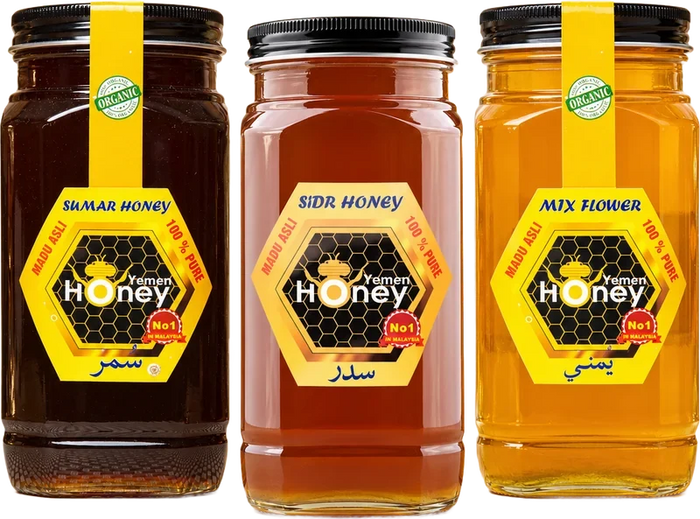
Honey isn't one fixed product. Its colour, thickness and taste change with the flower the bees visited, the season, the weather at harvest and how it's stored. Our Sumar is dark and bold, while our Marai is light and floral. Both are real honey from Hadramawt, Yemen, and they look nothing alike.
A fake, on the other hand, is usually made to look exactly like what buyers expect real honey to look like. That's why "it looks right" is never enough.
What actually tells real from fake
Only a laboratory can check honey properly. A lab looks at things you can't see at home, such as which sugars are in it, how much moisture it has, what pollen it carries, and signs of added syrup. If you want certainty, ask the seller for a lab report and check what it tested.
What you can check as a buyer
- A clear origin. The region, the flower and the harvest season, not just "100% pure". Our Sidr, Sumar and Marai pages each show the region, the flower and the harvest season.
- A taste before you buy. Real honeys taste very different from each other. A seller who lets you taste isn't afraid of the comparison.
- A price that makes sense. The Sidr tree flowers only once a year and the harvest is small. Very cheap "Sidr" deserves a question.
- A real shop and real people. Somewhere you can visit, and someone who answers when you message.
And if your honey turns grainy?
Many people decide their honey is fake the day it crystallises. It's a natural process in real honey, not a sign of sugar added. We explain why it happens, and how to soften it safely, in Why honey crystallises, and how to melt it safely.
Taste first. Trust after.
That's how we sell at our shop in Setapak, Kuala Lumpur. Come in, taste Sidr, Sumar and Marai side by side, and decide with your own tongue. Can't come by? Send PILIH on WhatsApp and we'll help you choose.